
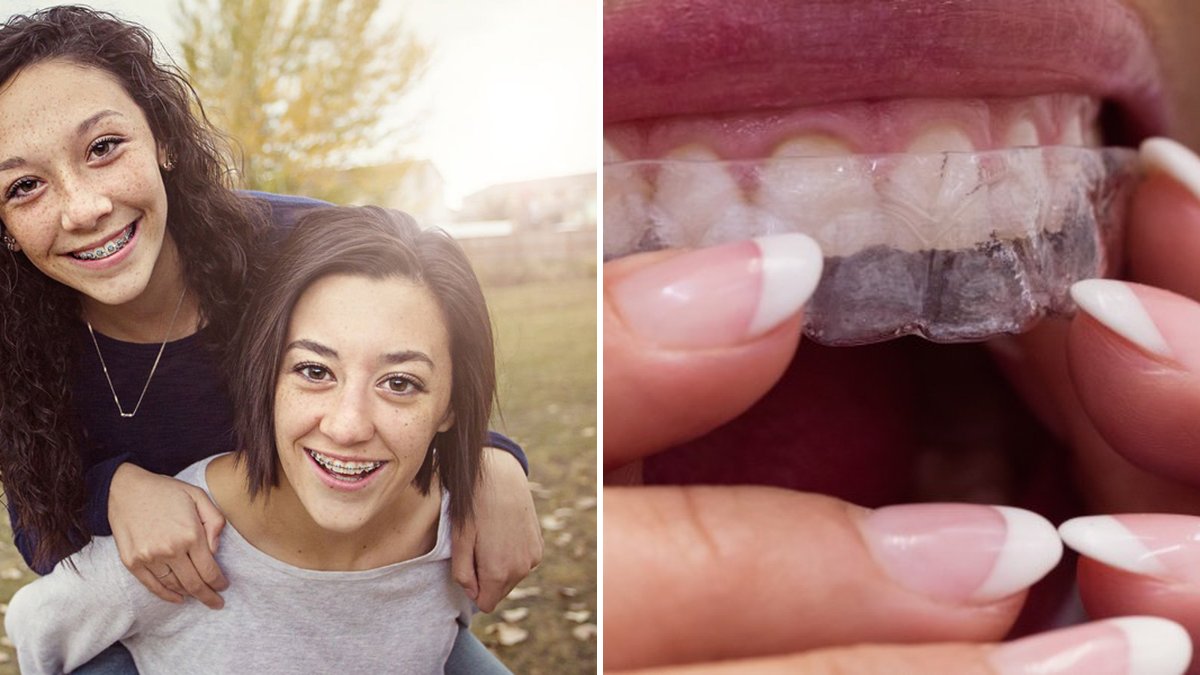
If you or your teen needs straighter teeth, the first big question is usually the same one: braces or Invisalign? Both work, both are common and both can give you a smile you’re proud of. They get there in different ways, though, and the right choice depends on your bite, your lifestyle and how much you want to think about your treatment day to day. Here’s an honest side-by-side to help you decide before your consultation.
Braces vs. Invisalign at a Glance
| Braces | Invisalign | |
|---|---|---|
| How they work | Brackets bonded to your teeth, connected by a wire your dentist adjusts | A series of custom clear trays, each one shifting your teeth a little further |
| Appearance | Visible | Nearly invisible |
| Removable? | No — they work around the clock | Yes, for meals and brushing — worn about 22 hours a day |
| Food rules | Skip hard, sticky and chewy foods | Eat what you like with the trays out, then brush before putting them back |
| Typical treatment time | Traditional braces: often a year and a half or longer. Fastbraces: often 3 to 12 months | Usually 6 to 18 months |
| Best for | Any case, including complex bite problems | Mild to moderate crowding, spacing and bite issues |
| Biggest commitment | Careful cleaning around brackets and wires | Wearing the trays consistently, every day |
How Braces Work
Braces use small brackets bonded to the front of each tooth, linked by a thin wire. At each visit your dentist adjusts the wire to apply steady, gentle pressure, moving your teeth into position over time. Because braces are fixed in place, they work 24 hours a day whether you remember them or not — and they give your dentist precise control over how each tooth moves, including rotations and bite corrections that are harder to manage with trays.
“Braces” doesn’t have to mean the long treatment you might remember from school. At daily DENTAL & bracesbar we offer conventional metal braces and Fastbraces, which treat the same problems — overbites, underbites, crossbites, gaps and crowding — and often finish in three to twelve months instead of a year and a half or more, with fewer office visits along the way.
How Invisalign Works
Invisalign replaces brackets and wires with a series of smooth, clear plastic aligners made from a 3D scan of your teeth. You switch to a new set every week or two, and each set moves your teeth a little closer to the final result. Before you start, the digital plan shows a preview of where your teeth are headed. You take the aligners out to eat, drink anything other than water, brush and floss, then put them right back in. Other clear aligner systems work the same way.
The Differences That Matter Most
Appearance
This is where Invisalign shines. The aligners are clear and fit snugly, so most people won’t notice them in conversation or photos. Braces are visible, though plenty of patients — especially teens — don’t mind, and some enjoy picking colors for their bands.
Comfort
Both cause some pressure for a few days whenever your teeth start moving to a new position, and that fades as you adjust. Aligners have no metal edges, so there’s nothing to rub against your cheeks or lips. With braces, a little orthodontic wax over a bracket helps while your mouth gets used to them.
Eating and Cleaning
With Invisalign you remove the trays, eat normally, and brush and floss the way you always have. With braces, you’ll avoid foods that can bend a wire or pop off a bracket — think popcorn, hard candy, caramel and biting straight into apples — and you’ll need a little extra care to clean around the hardware. Our guide on how to clean your teeth with braces walks through the routine.
Treatment Time
For many mild to moderate cases, Invisalign and Fastbraces both finish in well under two years. Traditional braces often take a year and a half or longer, particularly for bigger bite corrections. Your actual timeline depends on how far your teeth need to move, which is why the consultation matters more than any average.
Complex Cases
Aligners handle crowding, spacing and many bite problems well. Severe crowding, large bite discrepancies and teeth that need significant rotation or vertical movement are usually treated more predictably with braces. If your case is one of these, we’ll tell you up front.
Discipline
Invisalign only works when you wear it — about 22 hours a day. Leave the trays in a drawer and your teeth stop moving. Braces take that decision off your plate. Be honest with yourself (or about your teenager) here: for some people, the freedom to take aligners out is a perk; for others, it’s a temptation.
Cost and Insurance
Cost depends far more on how complex your case is and how long treatment takes than on which option you pick. Dental plans with orthodontic coverage generally apply those benefits to braces or Invisalign. We accept most major dental insurance plans at our Dublin, Gahanna and Grove City offices, and financing through CareCredit and Sunbit can spread the cost into monthly payments. You’ll get real numbers for your case at your consultation.
Braces May Be the Better Fit If…
- You have severe crowding or a significant overbite, underbite or crossbite
- You want the shortest possible treatment and qualify for Fastbraces
- You (or your child) are likely to forget to wear removable trays
- You’d rather not think about your treatment between visits
Invisalign May Be the Better Fit If…
- You have mild to moderate crowding, gaps or bite issues
- You want your treatment to be as discreet as possible at work, school or on camera
- You don’t want food restrictions
- You’re confident you’ll wear the aligners consistently
What About Teens vs. Adults?
Both options work for teens and adults. Teens are often great Invisalign candidates if they’re responsible about wearing their trays, and braces remain a reliable choice when consistency is a worry. Adults tend to lean toward Invisalign for its discreet look, and there’s no age limit as long as your teeth and gums are healthy — see Invisalign for adults for more. Wondering whether your child is ready at all? Read do all baby teeth have to fall out before braces.
Frequently Asked Questions
Is Invisalign as effective as braces?
For mild to moderate crowding, spacing and bite problems, Invisalign can deliver results comparable to braces when the aligners are worn as directed. For more complex bite problems, braces usually give more predictable control. A 3D scan at your consultation shows which approach fits your teeth.
Which is faster, braces or Invisalign?
It depends on your case. Invisalign usually takes 6 to 18 months and traditional braces often take a year and a half or longer, but Fastbraces often finish in 3 to 12 months. Your dentist can estimate your timeline after an exam.
Does insurance cover Invisalign the same as braces?
Many dental plans that include orthodontic coverage apply those benefits to either braces or Invisalign, up to the plan’s lifetime orthodontic maximum. Our team checks your benefits and walks you through financing options before you start.
Can I switch from braces to Invisalign during treatment?
Sometimes. Depending on how your teeth are moving and what’s left to correct, your dentist may be able to finish treatment with aligners. It’s best decided case by case at a progress visit.
Will I need a retainer after braces or Invisalign?
Yes. Teeth naturally try to drift back after any orthodontic treatment, so everyone wears a retainer afterward to keep their new smile in place.
Not Sure Which Is Right for You?
You don’t have to decide on your own. At a consultation we’ll examine your bite, take a 3D scan and explain which options will work for your teeth — braces, Fastbraces, Invisalign or clear aligners — along with the timeline and cost of each. Book a consultation at our Dublin, Gahanna or Grove City office. We’re open Saturdays and Sundays, so it’s easy to fit in.
Ready to Get Started?
Schedule your appointment today at any of our three convenient locations.
Book an Appointment